The demand for private tuition to support academic recovery post-pandemic and post-ESSER funding doesn't appear to be slowing down. The US tuition market is projected to grow by $28.85 billion between 2025 and 2029, making it an attractive and lucrative industry to get into.
On top of this, the academic success of US students has deteriorated and, according to PISA, the OECD's Program for International Student Assessment, has been stagnant for decades. These factors combined mean that private tutoring on top of mainstream education has become essential in making sure students achieve strong academic performance.
But how much do private tutors charge these days? Let's look at some average tutoring rates in the US to help you to benchmark your own rates.
What are the average tutoring rates in the US in 2026?
Tutoring rates vary from state to state and subject to subject, but on average, a private tutor costs roughly between $25 and $80 an hour in the US. The Bureau of Labor Statistics (BLS) reports the median annual wage for tutors in 2024 was $40,090. The rates you charge may vary depending on a variety of factors, including a tutor's education level, expertise, and the difficulty of the subject, to name a few.
Another factor affecting tutoring rates is whether you join or run a tuition business or become an individual tutor. Tuition businesses can charge between $25 and $125 per hour, whereas individual tutors charge between $15 and $75. To this category, we can also add tutoring centers – larger, well-established agencies that can, on average, range from $150 to $300 a month.
On the other hand, you could work in test prep tutoring. Rates for test prep tutors can be significantly higher than the regular weekly or monthly tutoring rate, due to the intense and time-sensitive nature of the tuition. The tutoring price per hour for test preparation is on average $65 to $150, with 1:1 specialists in major cities charging as much as $200 per hour.
Find out more about test prep pricing in our dedicated article.
How different factors affect tutoring rates

When it comes to tutoring rates, a range of factors influence the final cost per hour. Location, subject, student grade level, and tutor expertise all play a role in determining how much you’ll charge (or pay) for private tuition.
Whether you’re a math tutor in a high-cost city or a language tutor for advanced studies, understanding these factors can help you to set prices effectively and make sure you are the right fit for your client's needs.
Let’s explore how each element impacts tutoring prices.
1. Location
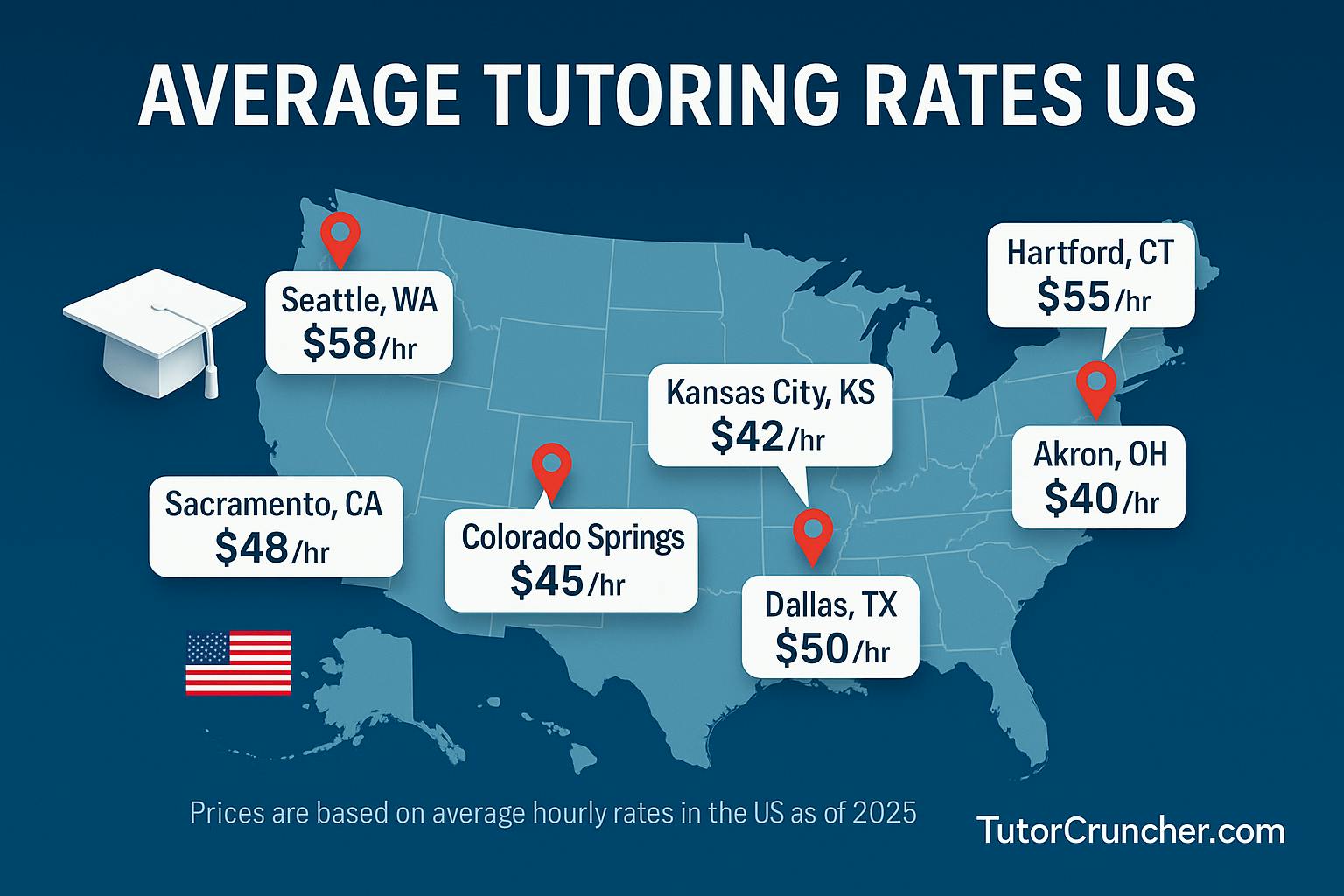
A key defining factor that will affect tutoring rates is location. Certain states have higher than average tutoring costs; therefore, it is important to check the average rate for tutoring in your area. For example, the average math tutor in New York costs between $55-65 per hour. However, the average price is $50-60 per hour in Los Angeles, and Chicago tutors charge around $45-55 per hour.
Other key cities include:
- Seattle, Washington: $55-65/hr
- Hartford, Connecticut: $52-62/hr
- Dallas, Texas: $48-58/hr
- Sacramento, California: $45-55/hr
- Colorado Springs, Colorado: $42-50/hr
- Akron, Ohio: $38-46/hr
- Kansas City, Kansas: $40-48/hr
Source: Care.com *Please note that these values are approximate and will vary depending on individual services.
It comes as no surprise that tutoring costs, or tutoring prices, are higher in cities and states where average salaries and the cost of living are high. It's also important to take travel into consideration and allocate enough budget to cover fuel or transport costs in your specific area.
Online tutoring has the potential to eliminate these additional costs, but more on that later.
2. Subject
Math is unquestionably the most requested subject for tutoring all over the world, but especially in the US. The high demand for math tutors means it comes at a higher cost, around $30 to $60 per hour. Similarly, physics, and chemistry can reach equally high tutor rates per hour, as they are similarly difficult subjects and also involve calculus.
English typically follows the more numerical subjects in terms of higher cost in the US. Students from all over the world are choosing international universities where subjects are taught in English, increasing it's popularity and cost.
Here are some typical prices per hour for tutoring by subject:
- Math: $52.50
- Physics: $40.50
- Chemistry: $75.00
- English: $32.50
- Science: $27.50
- Spanish: $27.50
- French: $27.50
- Japanese: $60.00
- Korean: $60.00
- Mandarin: $60.00
Foreign languages are also very popular for tutoring, with many students wishing to master new languages for further study or opportunities to travel and work abroad in the future.
Mandarin, Japanese, and Korean have some of the highest tutoring rates, whereas Spanish and French are much more affordable. This is likely because they are Latin languages, which are slightly easier to learn from English.
3. Student's grades
Tutor pay rates also change along with students' grades. Whether in elementary school, middle school, or high school, the tutor rate per hour will vary. Prices will usually change according to the difficulty level of the tutoring. For example, exam preparation has a higher associated tutoring fee compared to help offered with homework or assignments.
Some typical tutoring rates by grade are as follows:
- Elementary school: $23 to $75 per hour
- Middle school: $25 to $88 per hour
- High school: $30 to $100 per hour
- College tutors: $60 to $110 per hour
For higher education, prices are much more significant than for K-12, partly because the subjects are more complex and specific to a profession.
4. Expertise
When opting for personal or private tutoring, the tutors' level of expertise may vary, which ultimately has an impact on the final tutor rate per hour. Personal tutors can be either self-taught experts or professionally trained teachers with years of experience.
Your qualifications and experience matter in this case, but that doesn't mean that a less experienced tutor hasn't got the knowledge necessary to provide extraordinary lessons for pupils.
Something to showcase is any extra certificates and diplomas you may have, as this directly affects your tutoring price per hour.
What's a fair tutoring rate per hour?

It's important to acknowledge fairness in tutoring rates for both tutors and parents. As a tutor, you should feel like you're being fairly paid for the service you provide and the hours you put into preparation ahead of the lessons.
Similarly, parents want to pay a fair tutor rate per hour, especially considering that supplementary education can be expensive and some are budgeting especially for this.
To make sure your tutoring rate is fair, here are some important things to consider:
- Tutor's qualifications and years of experience
- The age and level of education of students
- The tutoring subject
- If it is private tutoring, online tutoring, tutoring group sessions, or based in a tutoring center
Costs of online tutoring vs home tutoring

Nowadays, hiring tutors online is largely more affordable compared to in-person lessons. Online tutoring services typically charge set monthly or hourly fees for tutoring, while in-person tutoring may incur additional fees for travel time and other costs involved, such as study materials.
The rate per hour for online tutoring is between $25 and $60, whereas in-person classes or group tutoring sessions can get $80 per hour and more.
Pre-pandemic, online tutoring was a less popular option due to worries that it may not be as engaging as in-person lessons. However, the last few years have caused a significant shift in views toward online learning, and is now looked upon more favorably.
With the rise of online education and the help of platforms like Zoom, Teams, and Google Meet, tutors have had to adapt to new teaching skills to accommodate virtual learning.
Benefits of online tutoring:
- Availability: You can find tutors available at any time of the day, who teach more specialized knowledge, and you can be taught from anywhere in the world.
- Multitude of choices: With online tutoring, you have the opportunity to choose your preferred online tutoring platform.
- Inclusivity: Tutoring online is available for everyone, regardless of age or background, or if you cannot travel, or have a disability.
- Comfort: The opportunity to study from home guarantees a comfortable and safe learning environment.
- Performance record: With lessons online, tutors can easily utilize analytics to keep track of pupils' performance over time. This can also be made accessible to parents so they can be confident that they are getting their money's worth.
- Easy payments: Virtual tutors can schedule easy payments and keep records of payments with ease.
How much does AI tutoring cost?
The emergence of AI tutoring in the US in recent years has given many students the opportunity to access low-cost tuition. These platforms often sit at a much lower price point, with subscription-based models charging between $0-$20 per month.
What's clear is that while new AI tutors offer some benefit to students, they also come with risks. Human tutors, who can build relationships with students, are still best-placed to deliver tutoring and therefore worth paying for.
At the moment, AI tutoring is very new, and it's unclear whether it will make a significant difference to the traditional tutoring sector. AI tools may help you to run your tutoring business more effectively and can support you in delivering better lessons overall.

There are many factors that ultimately affect the average tutoring rate per hour, including the type of tutoring, location, subject, student's grade or age, and tutor's experience and expertise.
Each of these factors will have a varying impact on the way in which you approach tutoring, so before making your final decision on what to charge (or pay), consider the following steps:
- Determine your budget: Based on your experience level, subject, location, existing qualifications, and the budget you need to earn per month, consider which price bracket best fits your business.
- Consider your options: Do you prefer to teach in-person or online? Would you consider working in a tutoring centre?
- Be realistic: Choose the best option for you that you will be able to maintain long-term. Consider trying a couple of options before settling on the type of tutoring that works best for you.
- Ask for help: If you get stuck, ask other tutors and tutoring businesses for advice. You will be surprised at how much extra support is out there and how many people are sharing a similar experience with you.
Becoming a tutor can be a rewarding and lucrative career. With the option to start your own business and scale, it's a great opportunity for educators who love the freedom and flexibility of working for themselves or as part of an agency.
Setting your rates doesn't need to be a headache. Using the guide above, you should have a clearer idea of how to set a fair rate for your business. It's now time to go out and find some clients - best of luck!
Thinking of starting your own tutoring business? Contact us at info@tutorcruncher.com or book a call with one of our US or UK-based team. We’re here to help.